

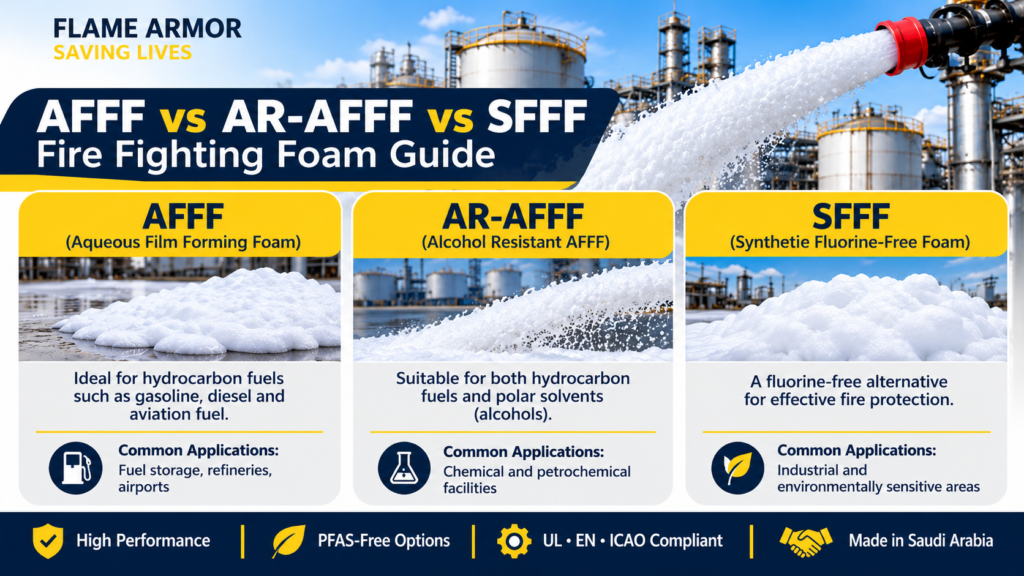
AFFF vs AR-AFFF vs SFFF: Understanding the differences between these firefighting foam types is essential for selecting the right fire protection solution. Each foam concentrate offers unique performance characteristics for industrial facilities, fuel storage areas, airports, and other high-risk environments.
Three important categories of firefighting foam are AFFF (Aqueous Film Forming Foam), AR-AFFF (Alcohol Resistant Aqueous Film Forming Foam), and SFFF (Synthetic Fluorine-Free Foam).
Although these foam types are designed to help control flammable liquid fires, their chemical characteristics, compatibility, and performance requirements differ.
In this guide, Flame Armor, a firefighting foam manufacturer in Saudi Arabia, explains the main differences and how to select the appropriate foam for your application.
1. AFFF vs AR-AFFF vs SFFF: What Is AFFF Fire Fighting Foam?
AFFF stands for Aqueous Film Forming Foam. It is traditionally formulated with fluorinated surfactants that enable the foam solution to form a thin aqueous film over certain hydrocarbon fuels.
This film helps suppress flammable vapors, while the foam blanket separates the fuel surface from oxygen and provides cooling.
Common AFFF Applications
- Petroleum storage facilities
- Oil refineries and petrochemical plants
- Fuel loading and unloading stations
- Industrial hydrocarbon fire protection systems
- Suitable airport firefighting applications
AFFF is commonly used for hydrocarbon fuels such as gasoline, diesel, and aviation fuel, subject to the product’s tested performance and system compatibility.
Traditional AFFF formulations are not generally suitable for direct application to polar solvents without alcohol-resistant properties.
2. What Is AR-AFFF Fire Fighting Foam?
AR-AFFF stands for Alcohol Resistant Aqueous Film Forming Foam.
This foam category is designed for applications involving both hydrocarbon fuels and certain polar solvents, including alcohols and other water-miscible flammable liquids.
Polar solvents can break down conventional foam blankets. Alcohol-resistant formulations contain specialized components that help create a protective barrier between the fuel and the foam.
Common AR-AFFF Applications
- Chemical manufacturing facilities
- Alcohol and solvent storage areas
- Pharmaceutical and chemical processing plants
- Petrochemical facilities handling multiple fuel types
- Industrial locations with mixed flammable liquid hazards
AR-AFFF is particularly useful where both hydrocarbon and polar solvent fire risks are present.
The correct concentration and application method depend on the fuel, foam formulation, and applicable fire protection system requirements.
3. What Is SFFF Fire Fighting Foam?
SFFF stands for Synthetic Fluorine-Free Foam.
Unlike conventional fluorinated AFFF, SFFF is formulated without intentionally added fluorinated surfactants.
SFFF products are increasingly considered by organizations seeking alternatives to fluorinated firefighting foams.
These formulations rely on foam blanket formation, vapor suppression, and cooling rather than the fluorinated film-forming mechanism traditionally associated with AFFF.
Common SFFF Applications
- Industrial fire protection systems
- Hydrocarbon fuel storage areas
- Selected aviation firefighting applications
- Facilities transitioning away from fluorinated foams
- Applications where fluorine-free formulations are specified
Not all SFFF products are suitable for polar solvents. Where alcohol resistance is required, an appropriate alcohol-resistant fluorine-free formulation must be selected.
Important: Fluorine-free composition does not automatically establish suitability for every fire hazard or firefighting system. Performance testing and equipment compatibility remain essential.
4. AFFF vs AR-AFFF vs SFFF: Key Differences
| Feature | AFFF | AR-AFFF | SFFF |
|---|---|---|---|
| Main characteristic | Aqueous film-forming performance | Alcohol-resistant foam protection | Fluorine-free formulation |
| Hydrocarbon fuel applications | Yes, where approved | Yes, where approved | Formulation-dependent |
| Polar solvent applications | Generally unsuitable | Designed for specified polar solvents | Requires a suitable AR formulation |
| Fluorinated surfactants | Traditionally present | Traditionally present | Not intentionally added |
| Typical applications | Fuel storage and industrial facilities | Chemical and mixed-fuel facilities | Fluorine-free fire protection applications |
| Selection requirements | Tested fuel and system compatibility | Fuel-specific concentration and compatibility | Tested performance and system compatibility |
5. How to Choose the Right Fire Fighting Foam
Selecting firefighting foam requires more than comparing product names or concentration percentages.
Identify the Fuel Hazard
Determine whether the protected facility handles hydrocarbon fuels, polar solvents, or a combination of both.
Check the Required Concentration
Foam concentrates may be supplied at different nominal induction rates, such as 1%, 3%, or 6%.
The correct rate must match the specific product’s instructions, the fuel hazard, and the proportioning equipment.
Verify Relevant Testing Standards
Depending on the application, relevant standards and test methods may include:
- UL 162 – Foam Equipment and Liquid Concentrates
- EN 1568 – Fire extinguishing media: foam concentrates
- ICAO – Airport rescue and firefighting foam performance requirements
Testing against a standard should not be confused with formal product listing or certification.
Evaluate System Compatibility
Foam performance depends on several factors, including proportioning accuracy, discharge devices, application rates, water quality, and operating conditions.
Before changing foam types, the existing firefighting system should be assessed for compatibility.
Consider Environmental Requirements
Environmental regulations, discharge management, disposal procedures, and the presence of fluorinated substances can influence foam selection.
Where fluorine-free performance is required, review the manufacturer’s technical documentation and supporting test information.
6. Fire Fighting Foam Solutions from Flame Armor
Flame Armor for Industry is a Saudi firefighting foam manufacturer providing foam concentrates for industrial fire protection applications.
Our product range includes:
- AFFF 1%, 3%, and 6%
- Alcohol-resistant firefighting foam concentrates
- Synthetic fluorine-free foam concentrates
- Alcohol-resistant fluorine-free foam formulations
- Fluoroprotein and high-expansion foam concentrates
Flame Armor provides technical product information to help customers evaluate appropriate foam solutions for their operating requirements.
Product-specific testing, applicable standards, and supporting documentation should be reviewed for each formulation.
7. Frequently Asked Questions
What is the main difference between AFFF and AR-AFFF?
AFFF is primarily associated with hydrocarbon fuel protection, while AR-AFFF is formulated to provide protection against specified polar solvents as well as suitable hydrocarbon fuels.
Is SFFF the same as AFFF?
No. SFFF uses a fluorine-free formulation, while conventional AFFF uses fluorinated film-forming chemistry. Their firefighting mechanisms and equipment compatibility may differ.
Can SFFF replace AFFF in an existing system?
Possibly, but replacement requires evaluation of the selected foam’s tested performance, proportioning equipment, discharge devices, and applicable requirements.
Which firefighting foam is best for industrial facilities?
The best foam depends on the fuel hazard, firefighting system, required performance standards, and environmental considerations.
Conclusion: AFFF vs AR-AFFF vs SFFF – Choosing the Right Foam
Understanding the differences between AFFF, AR-AFFF, and SFFF helps facility operators make informed fire protection decisions.
Each foam category offers specific advantages, and selecting the correct formulation requires consideration of fuel compatibility, testing standards, system design, and operational requirements.
When comparing AFFF vs AR-AFFF vs SFFF, the right choice depends on the fuel type, operating conditions, environmental requirements, and applicable fire protection standards. Each foam type has specific advantages, making proper product selection essential for effective fire safety.
Looking for firefighting foam in Saudi Arabia?
Contact Flame Armor for Industry for product information, technical documentation, and a quotation tailored to your facility’s requirements.